Turning the corner together: Why South Africa’s direction matters more than our doubts
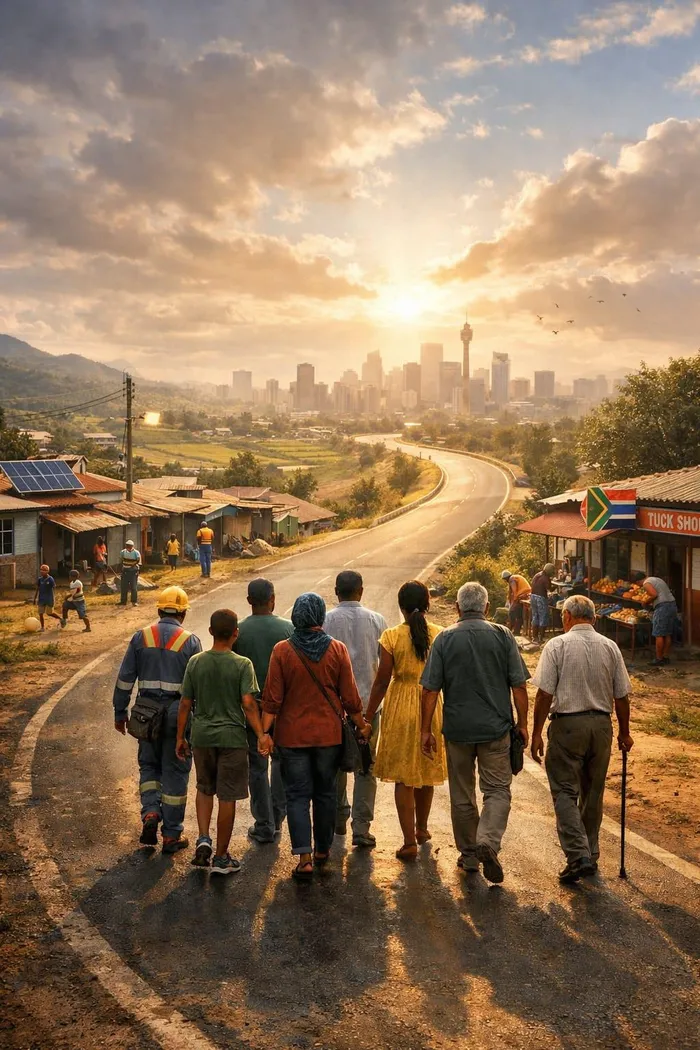
Walking together into a brighter South Africa: Small steps, shared effort and hope guiding the way forward.
Image: Chat gpt
South Africans are not short of pain. We carry it in our bodies, in our wallets, in our neighbourhoods, and in our conversations.
We have learned, often the hard way, to distrust good news. Too many times, optimism was used to paper over injustice, to silence anger, to delay real change. So when someone says “things are improving, our instinct is to push back.
That instinct is understandable. But it can also blind us. That is why I want to begin by acknowledging Ravin Singh. His recent reflection, grounded in facts rather than slogans, does not ask us to deny our suffering. It asks us to see clearly.
And seeing clearly is the first step to changing anything that matters. Ravin reminds us that countries do not move in straight lines. They move in trends. When we look honestly at the data since 1 January 2025, one thing becomes clear: South Africa is no longer in free fall.
This does not mean the crisis is over. It means the direction is shifting. Consider the economy. South Africa recorded 2.1% year-over-year GDP growth, beating expectations in a challenging global environment. Inflation has been contained between 3% and 3.6%, giving working families a little breathing space. The current account deficit narrowed to 0.7% of GDP, while foreign reserves climbed above 70 billion US dollars.
These are not elite abstractions. They signal stability, and stability is oxygen for a society that has been suffocating. Revenue tells a similar story. SARS collected a record 2.303 trillion rand in gross revenue and ended the year 18 billion rand above target. For years, we spoke about a hollowed-out state. Revenue performance suggests that hollowing is being reversed. When rules begin to apply again, trust can slowly return.
Nowhere has the shift been felt more viscerally than in energy. Between April and October, South Africa recorded just 26 hours of load shedding, followed by more than 200 consecutive days without power cuts by December. Eskom’s energy availability factor improved by six percentage points. For households and small businesses, this is not a technical statistic. It is the difference between anxiety and predictability, between survival and planning.
Our state-owned enterprises, long treated as lost causes, are showing signs of discipline. Collectively, SOEs moved from a 16 billion rand loss to a 58 billion rand profit. Eskom swung from a 55 billion rand loss to a 16 billion rand profit. Transnet sharply reduced its losses while implementing a 127 billion rand capital plan.
PRASA restored 35 of 40 rail corridors and returned to profitability. These are not miracles. They are what happens when maintenance, management, and consequence replace chaos. Employment remains our deepest wound, but even here the trend has shifted. Two hundred and forty eight thousand jobs were added in the third quarter, and unemployment declined from 33.2% to 31.9%.
The YES Programme has now placed 200,000 young people into work since inception, injecting an estimated 10 to 12 billion rand into township and rural economies. This is not a transformation, but it is a movement.
And movement matters. Globally, South Africa is regaining standing. We exited the FATF greylist in October 2025, restoring financial credibility. The European Union expanded its investment commitment to 11.5 billion euros, covering infrastructure, energy, critical minerals, and health manufacturing. A 500 million US dollar Africa100 allocation will support renewable energy and transmission. Despite punitive US tariffs, South African exports to the United States rose by 37% between January and October 2025. That is not luck. It is resilience.
Yet to speak of recovery without honesty would be betrayal. The shadow economy is real. Mafia-style extortion, corruption networks, municipal collapse, and obscene inequality remain part of daily life for millions. Growth, if left unattended, will once again favour those who have always benefited. Ravin is explicit about this, and he is right. Growth without structural change reproduces inequality.
But here is the greater danger we must name: the temptation to romanticise collapse. Cynicism has become fashionable. Despair has been mistaken for sophistication. We have talked the country down so relentlessly that many no longer believe improvement is possible, even when evidence begins to show otherwise. A nation cannot build what it does not believe can exist.
This is where consciousness matters, not as theory, but as practice. What we hold in mind, we move toward. If we hold only failure, we recreate it. If we hold a disciplined, grounded belief in possibility, anchored in evidence, we begin to align action, policy, and behaviour in that direction. South Africans understand this instinctively through sport. We are a Springbok nation not only because we win trophies, but because we know what winning requires: discipline, systems, accountability, humility, and belief under pressure. No shortcuts. No saviours.
Just doing the basics properly, again and again. That lesson is slowly returning to our public life. As we enter the festive season, I choose to speak as a proud South African, not a naïve one. The glass is not full. But it is no longer empty. And that matters more than we admit. I leave you with a simple truth to carry into the new year: Optimism is not pretending everything is fine. It is the quiet, stubborn conviction that together, we can make it better. Thank you, Ravin Singh, for reminding us to look at the direction, not only the damage.
May this season bring rest to weary families, courage to those rebuilding quietly, and renewed faith that South Africa, despite everything, is still worth choosing.
Faiez Jacobs is a former MP.
The views expressed do not necessarily reflect the views of IOL or Independent Media.